


The Purple Heart is a United States military decoration given to service members wounded or killed by enemy or hostile action. Most military medals recognize what someone did. This one recognizes what someone gave up.
It’s also one of the most recognizable medals in the American military. The purple heart shape, George Washington’s profile, that purple-and-white ribbon — you’d be hard pressed to mistake it for anything else.
But there’s more behind it than the shape and color, especially if one has landed in your family’s hands.
What Is the Purple Heart Medal?
The Purple Heart is the oldest American military award still given out today, and the story starts with George Washington himself.
On August 7, 1782, Washington created the Badge of Military Merit to honor soldiers for “singularly meritorious” action. The original badge was nothing more than a heart cut from purple cloth or silk, worn over the left breast. Only a handful of Revolutionary War soldiers ever got one, and the whole thing faded out once the war ended.
For about 150 years, that was it. Then in 1932, on the 200th anniversary of Washington’s birth, the award came back — this time as the Purple Heart we know today. That original 1782 date still carries weight, too. It’s the reason National Purple Heart Day falls on August 7 every year.
The eligibility rules shifted over the decades, and eventually the Purple Heart became what it is now: the award for service members wounded or killed as a result of hostile action.
That long history is part of why an inherited Purple Heart carries so much weight. It’s not just an old medal sitting in a relative’s things. It’s a physical link to one specific moment in that person’s service.
What Does a Purple Heart Look Like?
You’d probably recognize one even if you’d never seen one up close. Here’s what to look for:
- Shape: a purple enameled heart with a gold-colored border
- Front: a profile of George Washington in his Continental Army uniform
- Above the heart: the Washington family coat of arms between sprays of green leaves
- Ribbon: purple with narrow white edges
- Back: a raised bronze heart reading “For Military Merit” with space for the recipient’s name. Some Purple Hearts are engraved with the recipient’s name.
That last part matters more than people expect. If you’re trying to figure out whose medal you’re holding, flip it over. If the medal is engraved, the name on the reverse can help confirm who received it.
Who Receives a Purple Heart?
The Purple Heart is awarded in the name of the President to service members wounded or killed under qualifying circumstances involving enemy or hostile action.
In plain terms, that includes wounds caused by enemy or hostile action, along with certain qualifying circumstances such as friendly fire, terrorist attacks, and peacekeeping operations. What it doesn’t cover matters just as much. Not every injury in a combat zone qualifies — an illness, or a training accident that happens while deployed, generally doesn’t count. What matters is the circumstances of the wound and the official criteria behind it.
So this isn’t an award for being somewhere dangerous. It’s recognition of what it cost a service member when they were wounded, or lost their life, because of hostile action.
Is the Purple Heart the Highest Military Medal?
No. That’s the Medal of Honor.
But thinking about the Purple Heart in terms of the order of precedence kind of misses the point. Most decorations recognize something a service member did — an act of valor, an achievement, years of meritorious service. This one recognizes something that happened to them. Nobody sets out to earn a Purple Heart.
Which is exactly why, for a lot of recipients and their families, it ends up being the most personal medal in the whole collection.

What Does a Purple Heart Mean to a Family?
Sometimes the medal belongs to whoever’s reading this. Just as often, it belonged to a father, a mother, a grandparent, a spouse, a sibling.
Families often end up with a Purple Heart years after the fact, tucked in with discharge papers, photographs, letters, ribbons, maybe the original certificate. Put those pieces side by side, and they start telling someone’s story.
If you’ve inherited medals and aren’t sure what you’re looking at, start by just keeping everything together. Photos, documents, orders, citations, even a handwritten note — all of it adds context once you start piecing a relative’s service back together.
And if a medal’s missing? Don’t assume that part of the story is gone for good. Veterans and next of kin can often request military records, and replacement medals, through official channels.
How Do You Display a Purple Heart Medal?
There’s no single “right” way to display one. It really comes down to what you have, and whose story you’re telling.
Display the Purple Heart on Its Own
If the medal is the centerpiece, a dedicated Purple Heart medal frame keeps the attention exactly where it belongs.
A single-medal display is simple, it’s respectful, and it works especially well when the medal is being gifted to the recipient or passed down within the family.

Display the Purple Heart With Its Certificate
Have both the medal and the award document? Keep them together.
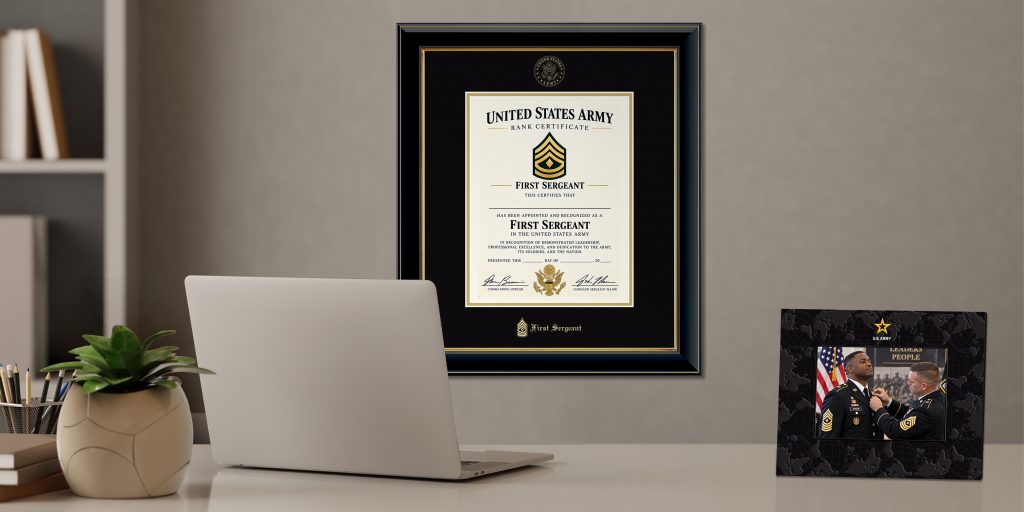
A Purple Heart certificate and medal frame does something a medal alone can’t — it tells the viewer not just what the medal is, but who received it and why it matters to your family. For an inherited Purple Heart especially, this tends to be the strongest choice, since the certificate gives the medal its context.
Use a Purple Heart Display Case for a Full Military Career
A Purple Heart display case can bring the medal together with photographs, ribbons, patches, challenge coins, insignia, and other awards that tell the larger story of a military career.
One medal rarely tells the whole story of a career. If you’ve also got photographs, ribbons, patches, challenge coins, insignia, or other awards, a larger military medal display case or a coordinated gallery wall might make more sense.
You might pair:
- the Purple Heart
- the award certificate
- a military portrait
- discharge or retirement documents
- other medals and ribbons
- rank insignia
The point isn’t to display everything the veteran ever owned. It’s to pick the pieces that actually tell their story.

Protecting a Purple Heart for the Next Generation
Whether the Purple Heart is yours or has been sitting in your family for decades, preservation matters.
Keep the medal and any paper documents away from moisture, heat, and direct sunlight. When you frame them, look for acid-free matting and UV-protective glass or acrylic — the same materials used to preserve fine art and important documents.
At militaryframes.com by Church Hill Classics, we handcraft military medal frames and display cases in the USA to help service members and their families hold onto the stories behind their service.
Because the real value of a Purple Heart was never really the metal or the ribbon. It’s who earned it, what it cost them, and the story your family carries forward from here.
Purple Heart Medal FAQs
When is Purple Heart Day? August 7 — the anniversary of the day George Washington created the Badge of Military Merit back in 1782. A lot of families use that day to display, share, or gift a framed Purple Heart.
Can you get a replacement Purple Heart? Often, yes. Veterans and next of kin can request replacement medals and military records through official government channels. Our guide to replacing lost or stolen military medals walks through how.
What does the back of a Purple Heart say? “For Military Merit,” and often the recipient’s name engraved beneath it. That engraving is frequently how families figure out who an inherited medal actually belonged to.
Is it disrespectful to frame a Purple Heart? Not at all. Framing one with preservation-grade materials is one of the more respectful things you can do with it. A medal displayed with care honors the person who earned it far more than one left sitting in a drawer.