A parent or grandparent passes away, and somewhere in the house you find a box.
Inside are medals, ribbons, dog tags, old photographs, maybe a folded flag or discharge papers. Some pieces are labeled. Most aren’t. And suddenly you’re the person trying to figure out what everything means and what your family should do with it.
If that’s where you are right now, don’t start cleaning or separating anything yet.
Photograph everything as you found it. Keep medals with their ribbons and devices. Set aside every piece of paperwork, even if it doesn’t look important. Then start putting the veteran’s story back together one piece at a time.
Start by leaving everything as you found it
It’s tempting to clean things up, especially if the medals have been sitting in a drawer or box for decades. Resist that urge until you know exactly what you have.
A few good first steps:
- Don’t polish the medals yet. Older finishes, patina, and markings can be part of the item’s history.
- Keep medals, ribbons, and devices together. A small oak leaf cluster, star, or “V” device can change the meaning of an award.
- Save every piece of paper. Citations, orders, discharge papers, letters, photographs, and handwritten notes can help identify what was earned.
- Take pictures before reorganizing anything. If everything was stored together for years, the original grouping may tell you something.
You can organize later. Right now, your goal is simply to avoid losing information.

How do you identify inherited military medals?
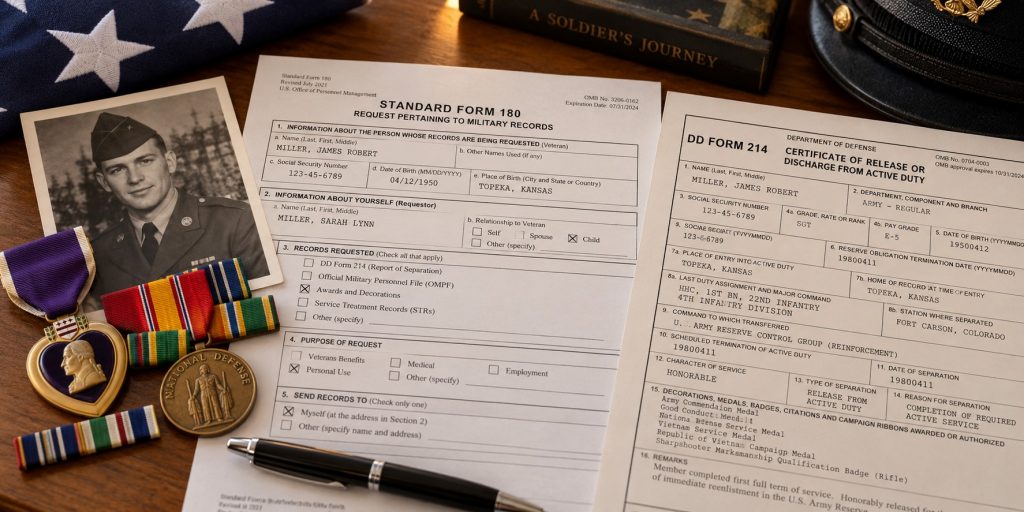
Start with the paperwork: a veteran’s DD Form 214, or older separation and discharge documents, may list decorations, medals, badges, citations, and campaign ribbons earned during service.
Compare that list with what’s in front of you.
If something appears on the paperwork but isn’t in the box, the medal may have been lost or never physically issued. If you find a medal that isn’t listed, don’t assume it belonged to someone else. Awards can be approved later, and military records can be corrected after separation.
Look for:
- DD Form 214
- DD Form 215 corrections
- Award citations
- General orders
- Discharge papers
- Promotion or retirement documents
- Photographs showing medals or ribbons in uniform
If you’re trying to determine how several medals belong together, our military medal order of precedence guide can also help you understand the proper display order.

Request the veteran’s military service record
If the paperwork is incomplete, the veteran’s military personnel record is the next place to look.
The National Archives allows eligible next of kin of deceased veterans to request military service records. For most non-archival records, that can include an un-remarried surviving spouse, parent, child, sister, or brother. Records become archival 62 years after a veteran separates from service, and different access and copying rules apply at that point.
The record may help confirm:
- Which medals and awards were earned
- Dates of service
- Units and assignments
- Separation information
- Other pieces of the veteran’s military history
You can begin through the National Archives’ Request Military Service Records page.
If medals are missing, replacement rules depend on the service branch, the age of the record, and who is requesting them. Our How to Replace Lost or Stolen Military Medals guide walks through that process in more detail.
How do you divide one veteran’s medals among family members?
This is often the hardest part: one original group of medals, one burial flag, several children or grandchildren, and no instructions about who should receive what.
There isn’t one right answer. There are a few ways families can handle it without breaking apart the veteran’s story.
Keep the original medal group together
If possible, consider keeping the original group of medals intact rather than giving one medal to each person.
Military medals often make more sense as a group. Together, they can show campaigns, accomplishments, commendations, and years of service that are difficult to understand when the pieces are scattered among several homes.
The family can choose one home for the originals and use the veteran’s service record to research replacement or reproduction options for other relatives. Because replacement rules vary by branch and record type, check the National Archives guidance before ordering anything.
A military medal shadow box can also keep the group displayed together rather than leaving the medals packed away in a drawer.

Divide the story, not the medal set
Another option is to share different pieces of the veteran’s history.
One family member might keep the medals. Another might have the burial flag. Someone else might receive photographs, a retirement certificate, or other documents.
Each person gets something meaningful without pulling apart an original medal grouping.
And when those pieces are displayed rather than stored away, the veteran’s story can live in more than one home.
Request additional Presidential Memorial Certificates
If the veteran was eligible, family members or close friends may be able to request a Presidential Memorial Certificate from the Department of Veterans Affairs.
This is especially helpful for siblings or grandchildren who each want something connected to the veteran’s service. The VA accepts multiple requests for Presidential Memorial Certificates. The certificate bears the current President’s signature and honors the memory of an eligible deceased veteran.
That means several family members can each have a meaningful piece of the memorial rather than trying to divide one original document.
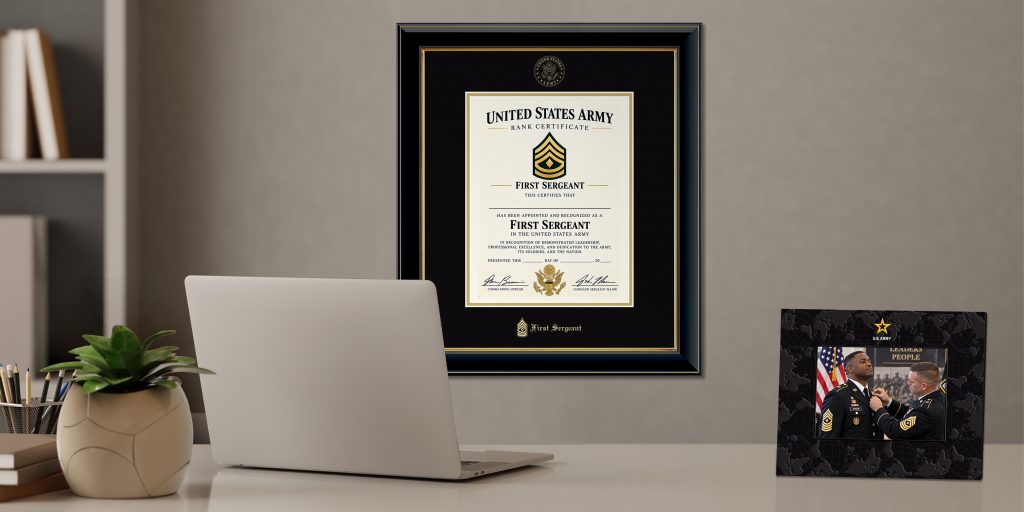
If you’d like to display one, a Presidential Memorial Certificate frame gives the certificate a permanent place alongside photographs, medals, or other family keepsakes.
What about the burial flag?
A veteran’s burial flag is different from the medals because there is normally only one.
The Department of Veterans Affairs says it cannot replace a burial flag that has been lost, destroyed, or stolen, although some veterans organizations may be able to help with a replacement.
If your family still has the original flag, handle and store it carefully.
A burial flag is larger than an everyday 3′ x 5′ flag, so it also requires the correct size display case. Our What Size Is a Burial Flag? guide explains what to look for before choosing one.
If you’re ready to display it, the Memorial Honors Flag Case is designed specifically for a burial or interment flag.
How to preserve inherited military medals
Once you know what you have, then you can think about how to protect it.
A few simple choices can make a big difference:
- Keep medals and ribbons out of direct sunlight.
- Avoid attics, basements, and other spaces with big temperature or humidity changes.
- Don’t attach medals with glue or tape.
- Use acid-free materials around medals, documents, and photographs.
- Keep citations and service documents with the medals whenever possible.
- Consider UV-protective glazing when displaying items that could fade.
If you’ve inherited several pieces, don’t feel like everything has to fit into one frame.
A medal shadow box, certificate frame, flag case, and one or two photographs can become a small military memorial wall. Instead of asking one frame to hold everything, each piece has room to stand on its own while still telling one connected story. It lets you tell more of the story while still giving each item enough room to matter.
MilitaryFrames offers military medal frames and shadow boxes designed for everything from a single decoration to a larger collection of medals. The current collection includes dedicated Purple Heart displays, medal and certificate combinations, and larger hardwood shadow boxes.

What if no one in the family can keep the medals?
Before throwing anything away or selling it, see whether someone else can preserve the history.
Depending on the veteran and the collection, you might contact:
- A veterans service organization
- The veteran’s unit or regimental association
- A local or state military museum
- A historical society with ties to the veteran’s hometown or unit
Ask how donated materials are cataloged and whether the veteran’s name and service history will remain with the collection.
That documentation can be just as important as the medals themselves.
Frequently Asked Questions About Inherited Military Medals
Who inherits a veteran’s medals?
Military medals generally become part of the veteran’s personal property and estate. Who ultimately receives them may depend on the veteran’s will, estate arrangements, and applicable state laws. If several family members are interested in the medals, it can help to agree on a plan that keeps the original group intact while finding meaningful ways to share the veteran’s story.
Can military medals be replaced?
In many cases, yes, but the rules aren’t identical across every branch. The veteran’s service branch, the age of the military record, and the relationship of the requester can all affect the process.
Start with the National Archives and our guide to replacing military medals before purchasing replacements.
Can you sell inherited military medals?
For U.S. medals, selling is restricted by federal law (18 U.S.C. § 704). The penalties are toughest for the Medal of Honor, the service crosses, the Silver Star, the Purple Heart and combat badges such as the Combat Infantryman Badge. Many families donate medals instead. Get advice before you sell.
What if a medal has a name engraved on it?
Leave the engraving exactly as it is. Names and other markings may help connect the medal to the service member and establish its history.
How do I know if I’ve inherited a Purple Heart?
The Purple Heart is a heart-shaped medal featuring a profile of George Washington on a purple ribbon with white edges.
If you have the medal along with its certificate, photographs, or citation, keep those pieces together. A Purple Heart medal frame can display the decoration on its own, while a medal-and-certificate frame can keep more of the story in one place.
What should I do with a veteran’s burial flag?
Keep it folded, dry, and protected from prolonged exposure to sunlight and moisture. If you’d like to display it, choose a case specifically sized for a burial flag rather than a standard household flag.
Give the story a place to live
Sometimes the most important thing in that old box isn’t any single medal.
It’s finally understanding what all of it meant.
The medal might tell you what your father earned. The citation tells you why. The photograph shows when. The flag tells another part of the story. Put together, those pieces give the next generation something much more valuable than a collection of objects.
At militaryframes.com by Church Hill Classics, we handcraft military displays in Monroe, Connecticut, for the medals, certificates, photographs, and flags families want to preserve.
Explore our military medal frames and shadow boxes for individual decorations or complete medal groups, or visit our military memorial gifts collection for certificate frames, flag cases, and other ways to create a lasting tribute.
Frame the Valor. Honor the Legacy.™