


Ask a Navy Chief about the day they were pinned and you won’t hear much about the pay raise.
That’s the Chief Petty Officer’s Creed doing its job. It’s where the Navy spells out, in plain language, that a Sailor selected for Chief hasn’t just moved up a paygrade. They’ve joined a fellowship, and the job itself changes because of it.
If someone you love is about to put on anchors, or you’re a Chief looking back on the day you did, here’s what the Creed actually says, where it came from, and why pinning day carries the weight it does.
What Is the Chief Petty Officer’s Creed?
The Chief Petty Officer’s Creed lays out the standards, responsibilities, and trust that come with becoming a Chief in the U.S. Navy. It’s traditionally read aloud when a First Class Petty Officer advances to Chief, usually somewhere in the middle of CPO initiation and the pinning ceremony itself.
It doesn’t read like a job description. That’s kind of the whole point. Its themes are leadership, mentorship, resilience, technical mastery, and a willingness to carry responsibility that’ll never show up in writing anywhere.
And it’s not some dusty relic, either. The required training for 2026 Chief selectees is literally called Teaching to the Creed. More than a century in, the Navy still builds the making of a Chief around these exact words.
Want to read the full text? Here is the verbiage as it appears on the official Chief Petty Officer’s Creed Frame:
United States Navy Chief Petty Officer Creed
DURING THE COURSE OF INITIATION, YOU HAVE BEEN CAUSED TO HUMBLY ACCEPT CHALLENGE AND FACE ADVERSITY. THIS YOU HAVE ACCOMPLISHED WITH RARE GOOD GRACE. POINTLESS AS SOME OF THESE CHALLENGES MAY HAVE SEEMED, THERE WERE VALID, TIME-HONORED REASONS BEHIND EACH POINTED BARB.
YOUR FAITH IN THE FELLOWSHIP OF CHIEF PETTY OFFICERS WAS NECESSARY TO OVERCOME THESE HURDLES. THE GOAL WAS TO INSTILL IN YOU THAT TRUST IS INHERENT WITH THE DONNING OF THE UNIFORM OF A CHIEF. OUR INTENT WAS TO IMPRESS UPON YOU THAT CHALLENGE IS GOOD; A GREAT AND NECESSARY REALITY WHICH CANNOT MAR YOU – WHICH, IN FACT, STRENGTHENS YOU.
IN YOUR FUTURE AS A CHIEF PETTY OFFICER, YOU WILL BE FORCED TO ENDURE ADVERSITY FAR BEYOND WHAT HAS THUS FAR BEEN IMPOSED UPON YOU. YOU MUST FACE EACH CHALLENGE AND ADVERSITY WITH THE SAME DIGNITY AND GOOD GRACE YOU HAVE ALREADY DEMONSTRATED.
BY EXPERIENCE, BY PERFORMANCE, AND BY TESTING, YOU HAVE BEEN ADVANCED TO CHIEF PETTY OFFICER. IN THE UNITED STATES NAVY – AND ONLY IN THE UNITED STATES NAVY – THE RANK OF E7 CARRIES WITH IT UNIQUE RESPONSIBILITIES AND PRIVILEGES YOU ARE EXPECTED TO FULFILL AND BOUND TO OBSERVE.
YOUR ENTIRE WAY OF LIFE IS CHANGED. MORE WILL BE EXPECTED OF YOU; MORE WILL BE DEMANDED OF YOU. NOT BECAUSE YOU ARE AN E7, BUT BECAUSE YOU ARE NOW A CHIEF PETTY OFFICER. YOU HAVE NOT MERELY BEEN PROMOTED A PAYGRADE, YOU HAVE JOINED AN EXCLUSIVE FELLOWSHIP AND, AS IN ALL FELLOWSHIPS, YOU HAVE A SPECIAL RESPONSIBILITY TO YOUR COMRADES, EVEN AS THEY HAVE A SPECIAL RESPONSIBILITY TO YOU. THIS IS WHY WE IN THE UNITED STATES NAVY MAY MAINTAIN WITH PRIDE OUR FEELINGS OF ACCOMPLISHMENT ONCE WE HAVE ATTAINED THE POSITION OF CHIEF PETTY OFFICER.
YOUR RESPONSIBILITIES AND PRIVILEGES DO NOT APPEAR IN PRINT. THEY HAVE NO OFFICIAL STANDING; THEY CANNOT BE REFERRED TO BY NAME, NUMBER, NOR FILE. THEY HAVE EXISTED FOR OVER 100 YEARS, BECAUSE CHIEFS BEFORE YOU HAVE FREELY ACCEPTED RESPONSIBILITY BEYOND THE CALL OF PRINTED ASSIGNMENT. THEIR ACTIONS AND THEIR PERFORMANCE DEMANDED THE RESPECT OF THEIR SENIORS AS WELL AS THEIR JUNIORS.
IT IS REQUIRED THAT YOU BE THE FOUNTAIN OF WISDOM, THE AMBASSADOR OF GOOD WILL, THE AUTHORITY IN PERSONAL RELATIONS AS WELL AS IN TECHNICAL APPLICATIONS. “ASK THE CHIEF” IS A HOUSEHOLD PHRASE IN AND OUT OF THE NAVY.
YOU ARE THE CHIEF. THE EXALTED POSITION YOU HAVE ACHIEVED — AND THE WORD EXALTED IS USED ADVISEDLY — EXISTS BECAUSE OF THE SERVICE, CHARACTER, AND PERFORMANCE OF THE CHIEFS BEFORE YOU. IT SHALL EXIST ONLY AS LONG AS YOU AND YOUR FELLOW CHIEFS MAINTAIN THESE STANDARDS.
IT WAS OUR INTENTION THAT YOU NEVER FORGET THIS DAY. IT WAS OUR INTENTION TO TEST YOU, TO TRY YOU, AND TO ACCEPT YOU. YOUR PERFORMANCE HAS ASSURED US THAT YOU WILL WEAR “THE HAT” WITH THE SAME PRIDE AS YOUR COMRADES IN ARMS BEFORE YOU.
WE TAKE A DEEP AND SINCERE PLEASURE IN CLASPING YOUR HAND, AND ACCEPTING YOU AS A CHIEF PETTY OFFICER IN THE UNITED STATES NAVY.

When Did the Navy Create the Chief Petty Officer Rank?
April 1, 1893. That’s when Chief Petty Officer became an official rate — the Navy’s word for an enlisted rank.
There wasn’t one single “first Chief.” Nine existing ratings shifted into the new grade all at once, including chief boatswain’s mate, chief gunner’s mate, chief quartermaster, and chief yeoman.
The title itself goes back further than that, actually. Navy historians trace the first informal use of “chief” to 1776, when cook’s mate Jacob Wasbie was designated chief cook aboard the Continental Navy ship Alfred.
The visual traditions came later still. The fouled anchor became the official cap device in 1905. The collar anchors Chiefs wear today? Those didn’t become official until 1959.
More than 130 years after that first April morning, the anchors are still one of the most recognized symbols in the entire Navy.
How Old Is the Chief Petty Officer’s Creed?
Younger than the rate itself. Nobody can say exactly how much younger.
Whoever wrote the original never got recorded anywhere. Early versions just spread from Mess to Mess through Chief initiations, not through any official Navy instruction — which, honestly, feels about right for a document that says its own responsibilities can’t be found in any file.
What we do know for sure is that the wording has kept evolving. The Creed got updated in the 1990s to better fit the modern Navy, and one of the more telling changes swapped out a line about enduring indignities and humiliation for one about accepting challenge and facing adversity. The Navy treats it as a living document, and it’s been refined again since then.
The core idea survived every rewrite, though: becoming a Chief means taking on responsibility for leadership, for standards, for Sailors, and for the reputation every Chief before you helped build.
What Does the CPO Creed Mean?
Most of it comes down to one line of thinking: more is expected of you now.
A new Chief isn’t just supposed to be technically excellent. Chiefs mentor. They teach. They solve problems. They develop junior Sailors, advise officers, enforce standards, and act as the connection between the wardroom and the deckplates. There’s a reason “ask the Chief” is basically a rule of thumb in the fleet.
The Creed doesn’t dance around it: “more will be expected of you; more will be demanded of you.”
Which is why pinning day hits the way it does. To a spouse, a parent, a child, or a friend sitting in the audience, it might look like a promotion ceremony. To the Sailor being pinned, it’s something closer to a change of identity.
The Creed on Pinning Day
Most Navy pinning ceremonies include a reading of the Creed. Every Chief in the room, past and present, stands at attention while it’s read.
For the full order of events, who pins the anchors, and what guests should wear, see our guide to what happens at a CPO pinning ceremony.
The Meaning of the Anchors
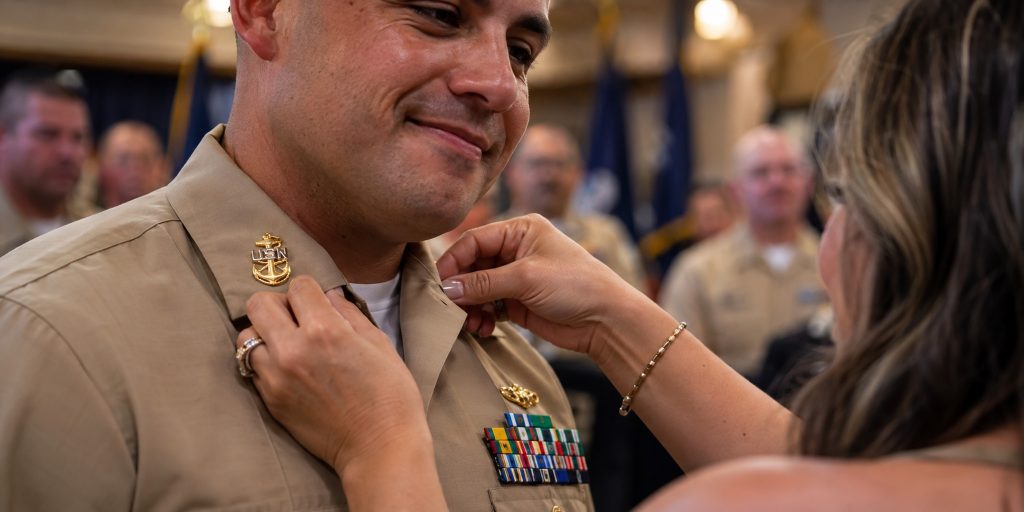
The anchors aren’t just new insignia. A gold fouled anchor on the collar announces entry into a leadership role with more than 130 years of history riding on it — and the moment they’re pinned is usually the one photograph families end up keeping forever.
IMAGE 1: Family member pinning anchors on a newly advanced Chief Alt text: Family pinning gold fouled anchors during a Navy Chief Petty Officer pinning ceremony
After the ceremony, those first anchors and the advancement certificate deserve better than sitting in a desk drawer somewhere. Our Gold Embossed Navy Rank Insignia Frame for Chief Petty Officer was built for exactly this milestone, with the CPO insignia embossed in gold.
The Chief’s Cover
Getting the combination cover is the other defining moment of the day.
Again, the symbolism outweighs the actual uniform item. A newly pinned Chief walks out of that ceremony looking different, because the Navy now expects them to lead differently too.

How Has CPO Initiation Changed?
If you’ve heard older stories about Chief initiation, know upfront: today’s process looks different by design.
Current Navy guidance treats initiation as leadership development — full stop, no asterisk. The 2026 guidance describes the final step, called Acceptance, as the Navy formally entrusting a new Chief with authority, accountability, and stewardship, while the Chiefs Mess takes on collective responsibility for continuing to develop and hold that Chief accountable going forward. That same guidance requires the whole process to meet the highest standards of conduct and respect. Degrading or humiliating treatment has no place in it.
The tradition is just as strong as it’s ever been. What’s changed is how carefully the Navy protects it.
Chief Petty Officer’s Creed vs. Sailor’s Creed
They’re related, but they’re not the same thing.
The Sailor’s Creed belongs to everyone in the Navy. It’s about service itself, and the core values of honor, courage, and commitment.
The Chief Petty Officer’s Creed belongs to the Chiefs Mess specifically. It’s about what changes on the day a Sailor becomes a Chief.
A lot of families end up displaying both — and we frame both. A Sailor’s Creed and photo frame marks the start of a Navy story. A Chief Petty Officer’s Creed frame marks the day that story changed direction.
Ways to Honor a New Chief
For a lot of Sailors, making Chief is the defining moment of a Navy career. Don’t let the photographs, the certificate, and those first anchors end up scattered across separate drawers.
A few ways families hold onto the day:
- Frame the Creed itself. Our Chief Petty Officer’s Creed frame keeps the words on a wall the Chief will actually walk past — the office, the home, wherever.
- Frame the new rank. The Gold Embossed Navy Rank Insignia Frame honors the advancement certificate with the Chief Petty Officer insignia in gold. And when Senior Chief or Master Chief comes later, we make those too.
- Build a small gallery. The Creed, the advancement certificate, a pinning photo, a favorite Navy photo, and eventually, a retirement or honorable discharge frame.
It doesn’t need to be elaborate. It just needs to feel like them.
Looking for more ideas? Our guide to the 11 best gifts for military promotions covers every branch and rank.

Chief Petty Officer’s Creed FAQ
What is the Chief Petty Officer’s Creed? It lays out the standards, trust, and responsibilities expected of a Navy Chief Petty Officer, and it’s traditionally read during CPO initiation and pinning ceremonies. The official text is maintained by the Naval History and Heritage Command.
Who wrote the Chief Petty Officer’s Creed? No one knows. The original author was never recorded, and the wording has been updated over the years, including in the 1990s.
When is the Chief Petty Officer’s Creed read? Traditionally during Chief Petty Officer Initiation and again at the pinning ceremony, where every Chief in the room stands while it’s read.
Is the Chief Petty Officer’s Creed official? The Navy’s own history command maintains the text, and the Creed anchors the required 2026 initiation training, called Teaching to the Creed. Fittingly enough, the Creed itself points out that a Chief’s real responsibilities show up in no official file.
At militaryframes.com by Church Hill Classics, every frame is handcrafted in our Monroe, Connecticut workshop, and we’re proud to help Navy families hold onto the milestones that become part of their story.
Becoming a Chief is one of the big ones.
Frame the Valor. Honor the Legacy.™